If you invest or trade in the stock market, you are already paying something called Securities Transaction Tax (STT), often without even noticing it. From April 1, 2026, some of these STT rates have been revised under the Finance Act, 2026.
Now, you might be wondering — what exactly has changed, and will it affect your trading cost or profits? Let’s understand this step-by-step in a simple way.
What is Securities Transaction Tax (STT) and Why Should You Care About It?
STT is a tax charged by the government on buying and selling securities like shares, futures, and options on a recognized stock exchange.
In simple terms, every time you trade, a small percentage is deducted as tax. You don’t have to calculate or pay it separately — your broker automatically deducts it.
This may look small, but if you trade frequently (especially in F&O), it directly impacts your overall cost and profitability.
What Has Changed in STT from April 1, 2026?
The Finance Act, 2026 has increased Securities Transaction Tax (STT) rates specifically for derivatives (Futures & Options). Let’s first understand the changes clearly:
- Sale of an option in securities has been revised to 0.15% (up to March 31, 2026 – 0.10%);
- Sale of an option in securities, where option is exercised, has been revised to 0.15% (up to March 31, 2026 – 0.125%); and
- Sale of futures in securities has been revised to 0.05% (up to March 31, 2026 – 0.02%).
These changes apply from April 1, 2026 onwards.
The key point here is that only derivatives are affected. Regular delivery-based equity transactions remain unchanged.
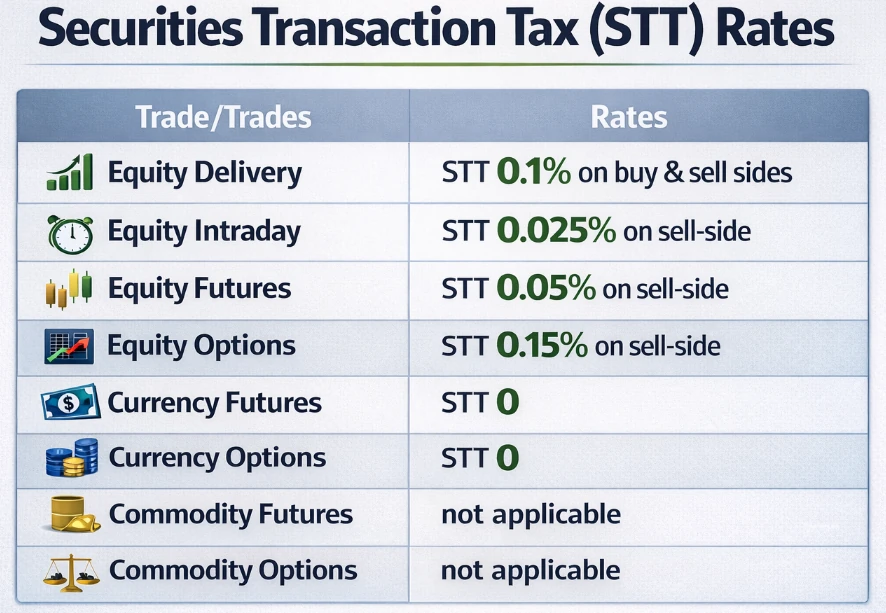
What is the STT Rate on Equity Delivery Trades?
If you are a long-term investor who buys and holds shares, there is no change for you.
Here is how it continues to work:
- Purchase of shares → 0.1% (paid by buyer)
- Sale of shares → 0.1% (paid by seller)
This means your investment cost structure remains exactly the same as before.
In simple terms, long-term investors are not impacted by this update.
What About Intraday Equity Trading?
Intraday traders (buy and sell on the same day) also see no change in STT rates.
STT on intraday sell side → 0.025%
Since this remains unchanged, equity intraday traders don’t face any additional tax burden.
How Are F&O Traders Affected by This Change?
This is where the real impact is. If you trade in futures or options, your transaction cost has increased due to higher STT rates.
Let’s break it down:
- Options Selling (Premium based) → STT increased to 0.15%
- Options Exercise (Settlement) → STT now 0.15%
- Futures Selling → STT increased to 0.05%
Now, this may look like a small increase, but in trading, even small percentage changes matter a lot.
For example: If you trade large volumes daily, this increase directly reduces your net profit or increases your loss.
Why Has the Government Increased STT on Derivatives?
The government’s intention is not random. There are two main reasons behind this move:
- To discourage excessive speculative trading in derivatives
- To increase tax revenue from high-volume traders
In recent years, F&O trading has increased sharply among retail traders. This change is a subtle way to make trading slightly more expensive and controlled.
What Should You Do as a Trader or Investor Now?
Instead of worrying about the change, it is better to adjust your approach.
Here are a few practical points to keep in mind:
- If you are an investor (buy and hold shares), there is nothing to worry about. There is no change for you.
- If you are an intraday trader, things remain mostly the same, so no major impact.
- If you trade in Futures & Options (F&O), you should be more careful, as your trading cost has increased and it can affect your profits.
Now the important insight is this:
Even a small increase in cost means your trading strategy needs to be more efficient. You may need better entry, better risk management, and fewer unnecessary trades.
Final Understanding (Simple Takeaway)
From April 2026, Securities Transaction Tax (STT) has increased only for derivatives — futures and options. Equity investors and intraday traders are not affected.
If you trade in F&O, your cost per trade has gone up. Over time, this can reduce your profitability if not managed properly. So, the focus now should shift from frequent trading to quality trading.
In the end, it’s not about how many trades you take — it’s about how efficiently you trade after costs.
Securities Transaction Tax (STT) Rates Applicable from 1st April 2026 (Summary)
| Taxable Securities Transaction | STT Rate w.e.f. 01/04/2026 |
|---|---|
| Purchase of an equity share in a company or a unit of a business trust (delivery-based, through recognized stock exchange) | 0.1% |
| Sale of an equity share in a company or a unit of a business trust (delivery-based, through recognized stock exchange) | 0.1% |
| Sale of a unit of an equity-oriented fund (through recognized stock exchange, delivery-based) | 0.001% |
| Sale of an equity share or unit (otherwise than by delivery, e.g., intraday) | 0.025% |
| Sale of an option in securities | 0.15% |
| Sale of an option in securities where option is exercised | 0.15% |
| Sale of futures in securities | 0.05% |
