If you are taking care of a dependent family member with a disability, the Income Tax Act 2025 gives you some financial relief. One important requirement for claiming this benefit is Form 30.
Many people know about deductions but miss the compliance part, which can lead to rejection of the claim.
In this guide, I’ll explain Form 30 in a very simple way—what it is, who should file Form-30, and how it actually works in real life.
What is Form 30 in Income Tax?
Form 30 is a document you need to submit when you want to claim a tax deduction for expenses made on a dependent person with a disability. This deduction is allowed under Section 127 and Section 154 of the Income Tax Act 2025.
In simple terms, the government is saying:
“If you are financially supporting a disabled dependent, we will reduce your taxable income—but you must provide proper proof.”
The deduction amount is fixed, not based on actual expenses.
- ₹75,000 → For normal disability
- ₹1,25,000 → For severe disability
This means even if you spend less or more, the deduction amount remains fixed.
The important thing to understand is that Form 30 acts as proof that your claim is genuine and supported by a certified medical authority.
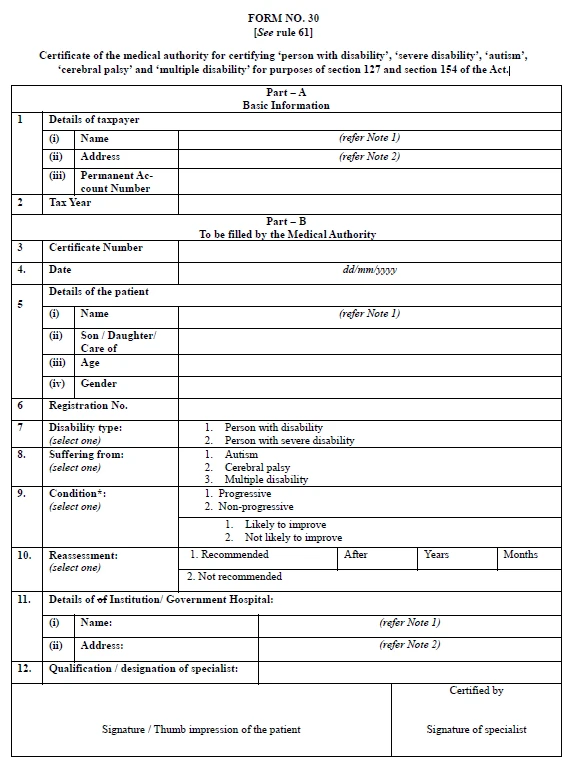
Note: Form 30 → Certificate of the medical authority for certifying a person with disability, severe disability, autism, cerebral palsy and multiple disability for purposes of section 127 and section 154 of the Act.
Who should file Form 30?
Form 30 is meant for resident individuals who are supporting a dependent with a disability. You should file this form if you are:
- Spending money on medical treatment (including nursing)
- Paying for training or rehabilitation
- Depositing money in approved schemes (like LIC or other insurers)
But there is one key condition — The person must be your dependent, such as:
- Spouse
- Children
- Parents
- Siblings
In real life, this applies to families where one member takes full responsibility for the care of a disabled person. The tax benefit is given to support this responsibility.
What is the due date to file Form 30?
Form 30 does not have a separate deadline. It must be filed along with your Income Tax Return (ITR). So, if your ITR due date is 31st July (for most individuals).
Then Form 30 must also be submitted before or on that date.
If you miss this, your tax deduction claim may not be accepted. That’s why it’s important to treat Form 30 as part of your tax filing process, not as an optional step.
What details are required in Form 30?
Form 30 collects basic but important information to verify your claim. It includes the following sections:
- Assessee details (Name, PAN, Address, Tax Year)
- Medical certificate details
- Patient details (Name, age, relation)
- Disability details (type, condition, severity)
- Hospital or institution details
- Doctor’s qualification and designation
This may look like a lot, but practically, most of this information comes from the medical certificate issued by the authority. The form simply organizes this information in a standard format so that the tax department can easily verify it.
What documents are required for Form 30?
The most important document is the medical certificate issued by an approved authority. This certificate must be given by:
- A Neurologist (MD in Neurology)
- A Paediatric Neurologist (for children)
- A Civil Surgeon or Chief Medical Officer in a Government hospital
Without this certificate, Form 30 has no value.
Also, you must upload a signed PDF of the certificate (Part B) while filing the form online.
In practical terms, think of this certificate as the backbone of your claim.
How to file Form 30 step by step?
Filing Form 30 is an online process and follows a simple flow. Here are the steps involved:
- Enter your personal details
- Add certificate and patient details
- Provide disability information
- Mention condition and reassessment details
- Upload signed medical certificate
- Complete verification
- E-verify using Aadhaar or DSC
Once submitted, the system processes your form, and your deduction is allowed based on the details you provided. The key point here is accuracy. Even small mistakes in details or missing uploads can lead to rejection.
Is the medical certificate required every year?
This depends on whether the disability is permanent or temporary.
- If the disability is permanent → Same certificate can be used
- If temporary → New certificate required after expiry
If the certificate expires and you still use it, your deduction may be denied. So always check the validity period mentioned in the certificate before filing.
Why is Form 30 important?
Form 30 is not just a form—it is the basis of your tax deduction approval. Without it:
- Your claim under Section 127 or 154 may be rejected
- You may lose tax benefits even if expenses are genuine
Many taxpayers make this mistake—they assume that showing expenses is enough. But in reality, documentation matters more than intention in tax compliance.
This is why Form 30 becomes crucial.
Conclusion
Form 30 is a simple but very important part of claiming tax deductions for disabled dependents. It connects your financial support with official medical proof.
The government allows the deduction, but only when you follow the proper process.
So always ensure your medical certificate is valid, your details are accurate, and Form 30 is filed along with your income tax return. This way, you not only save tax but also stay fully compliant and stress-free.