If you have paid more tax than you were actually required to pay for a financial year, you may be eligible for an income tax refund. This can happen when excess tax has been deducted as TDS, collected as TCS, or paid as advance tax or self-assessment tax.
An income tax refund can be claimed online by filing your Income Tax Return (ITR). Once the return is filed and e-verified, the Income Tax Department processes it and, if a refund is due, credits the amount to your bank account mentioned in ITR.
In this guide, we will understand what an income tax refund is, how to claim it, how to check your income tax refund status online, what the different refund status messages mean, how interest on refund works, and what you can do if your refund fails.
What is an Income Tax Refund?
An income tax refund is the excess tax returned by the Income Tax Department when the tax paid by a taxpayer is more than the taxpayer’s actual tax liability for a particular financial year.
For example, suppose your total tax liability for a financial year is ₹45,000, but ₹60,000 has already been paid as tax through TDS, TCS, advance tax, or self-assessment tax. The excess ₹15,000 may be refunded after the Income Tax Department processes your ITR.
The final tax liability is calculated after considering the applicable income, deductions, exemptions, and taxes already paid. If the amount already paid is higher than the amount actually payable, the difference becomes the refund amount.
Refunds can arise because of several situations, such as:
- Tax deducted (TDS) from salary, bank deposits, bonds, or other income is higher than the actual tax liability.
- Advance tax paid during the year is more than the tax liability determined during regular assessment.
- TDS or other tax has been deducted even though the taxpayer ultimately has no tax liability.
- The same income has suffered double taxation and the applicable rules allow relief.
The refund process begins only after the taxpayer files the income tax return and completes e-verification. Usually, it takes around 4–5 weeks for the refund to be credited to the taxpayer’s bank account.
If the refund is not received within this period, you should check whether there is any discrepancy or intimation relating to your ITR. You should also check your registered email for any communication from the Income Tax Department. The refund status can also be checked online through the e-Filing portal.
Example 1: Excess TDS on Salary
Suppose a salaried employee could not provide details of tax-saving investments to the employer within the required time. As the employer did not have those investment details while calculating TDS, more tax was deducted from the employee’s salary.
When the employee files the ITR and claims the eligible deductions, the final tax liability may be lower than the TDS already deducted. The employee can then claim the excess amount as a refund by filing the applicable ITR, such as ITR-1 or ITR-2.
Example 2: TDS on Professional Income
Now consider a self-employed professional whose business or professional receipts are subject to TDS.
After calculating the person’s final taxable income, it may turn out that there is no tax liability. In that situation, the tax already deducted (TDS) from the professional receipts can be claimed as a refund by filing the applicable return, such as ITR-3 or ITR-4.
The important point is that TDS is only a payment of tax during the year. Your final tax liability is determined when your income and applicable deductions are considered while processing the return.
How to Claim an Income Tax Refund?
You claim an income tax refund through your Income Tax Return. There is no separate informal claim that replaces the ITR.
Before filing the IT return, it is important to check your Annual Information Statement (AIS) and Form 26AS. These records help you verify whether the tax deducted by your employer, bank, customer, or another deductor has actually been reported against your PAN.
If the TDS is not reflected in your AIS and Form 26AS, the refund may not be issued for that amount.
This is why it is better to check your tax credits before filing the ITR rather than discovering a mismatch after the return has already been submitted.
If you are expecting a refund based on TDS, taxpayers are advised to wait at least until 10 June in cases where the relevant TDS filing deadline is 31 May. The deductor files the TDS details, and it can take around 2–3 days for those details to appear in AIS and Form 26AS.
If the TDS still does not appear, you should take up the matter with the deductor. If the deductor does not respond or resolve the issue, the matter can be taken up with the Income Tax Department or the Income Tax Officer of the deductor, as applicable.
Once the required tax information is correctly reflected, you can file the ITR and claim the refund.
How to Check Income Tax Refund Status?
Once your ITR has been filed and e-verified, you can check the income tax refund status online.
There are two commonly used ways to check the status:
- Through the refund-status facility on the Protean tax information network, traditionally referred to as the NSDL refund-status facility.
- Through your account on the Income Tax Department’s e-Filing portal.
The e-Filing portal provides a more detailed view because you can see the filed return and its processing status.
How to Check Income Tax Refund Status Through the Protean/NSDL Website?
You can use the refund-status facility provided through the tax information network.
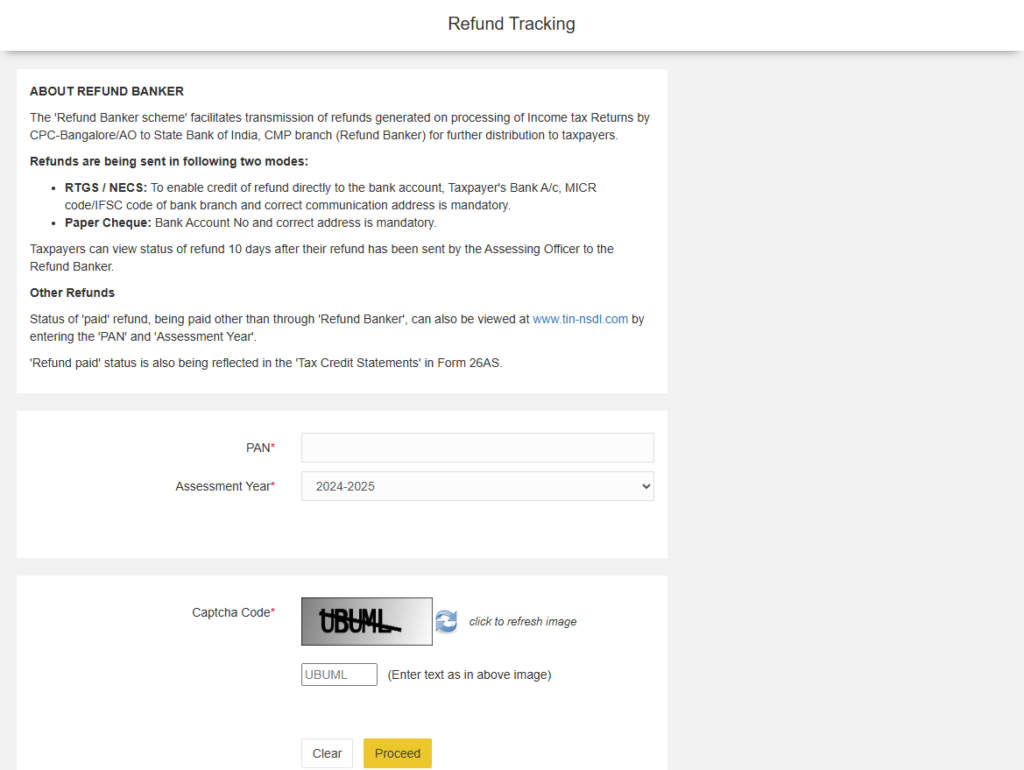
The basic process is simple:
- Open the refund-status page.
- Enter your PAN.
- Select the relevant Assessment Year.
- Enter the captcha code.
- Click on the option to proceed.
Your income tax refund status will then be displayed.
Here is the refund-status page link to check your the status
The important thing here is to enter the correct PAN and Assessment Year. A wrong Assessment Year can show a status that does not relate to the ITR for which you are waiting for a refund.
How to Check Income Tax Refund Status Through the e-Filing Portal?
You can also check your refund status directly through the Income Tax Department’s e-Filing portal.
Start by visiting the e-Filing portal and logging in using your user ID and password.
After logging in, follow this path:
e-File → Income Tax Returns → View Filed Returns
You will then see the returns that you have filed.
Select the relevant Assessment Year and choose View Details. You can view the life cycle of the filed ITR and check its current status.
On the subsequent page, you will see the list of previously submitted income tax returns. Select the acknowledgement number corresponding to the ITR in which you claimed the refund.
The page that opens will show the return details along with the income tax refund status.
This route is particularly useful when you want more than just the refund status because it allows you to see the broader processing history of the return.
What Does Your Income Tax Refund Status Mean?
The refund status can sometimes look confusing because the Income Tax Department uses specific terms to describe different stages of processing.
Understanding these terms makes it much easier to know what you need to do next.
Refund Paid
“Refund Paid” means your ITR has been processed and the refund has been credited or issued.
You should check your bank account to confirm that the refund has been received.
If the status shows that the refund has been paid but you have not received the amount, check with your bank. You may also need to contact the refund banker, such as the State Bank of India, to understand whether there was an issue with the payment.
No Demand No Refund
This means that your tax calculation matches the calculation made by the Income Tax Department.
You are neither required to pay additional tax nor eligible to receive a refund.
In such a situation, there is generally no further payment or refund action required.
Refund Status Not Determined
This means that your ITR has not yet been processed to the stage where the refund outcome has been determined.
In this situation, you generally need to wait and check the status again after a few days.
There is a difference between a refund being rejected and a refund status not being determined. The latter simply means that the processing has not reached the required stage.
Refund Determined and Sent Out to Refund Banker
This means that the Income Tax Department has accepted the refund and the refund banker has been informed.
At this stage, the refund is in the process of being paid.
You should wait for the amount to be credited. If the payment does not arrive, you can contact the refund banker to find out the status of the refund payment.
Refund Unpaid
“Refund Unpaid” means that the Income Tax Department has accepted the refund, but the amount has not been credited to you.
This can happen for reasons such as incorrect bank details or, where a cheque refund was opted for, an incorrect address.
The reason for the failed payment is generally displayed along with the status.
You should correct the relevant details and request a refund reissue where required.
Demand Determined
“Demand Determined” means that the tax calculation made by the Income Tax Department does not match your calculation and an additional amount of tax has been determined as payable.
In other words, instead of receiving a refund, you have an outstanding tax demand.
You should first compare the information in your e-filing records with your ITR and supporting tax records to identify the reason for the difference.
If you find that there was an error in your ITR and the demand is correct, you should pay the tax demand within the specified timeline.
If you believe there is no error in your return and the demand raised by the department is incorrect, you can file an appeal or use the applicable rectification process along with the supporting information and documents.
Rectification Processed, Refund Determined and Details Sent to Refund Banker
This status means that your rectification request has been processed and accepted by the Income Tax Department.
The refund amount has been recalculated and the details have been sent to the refund bank for processing.
You should check your bank account to confirm when the refund is credited.
Rectification Processed and Demand Determined
Here, the rectified return has been accepted, but the revised calculation has resulted in an outstanding tax demand.
You should cross-check the revised calculation and, if the demand is correct, pay the outstanding tax within the specified time.
If you believe the demand is incorrect, you should take the appropriate corrective action.
Rectification Processed, No Demand and No Refund
This means that the rectified return has been accepted, but the revised calculation does not result in either an additional tax demand or a refund.
In simple terms, the rectification process has been completed, but there is no further amount payable to you and no additional amount payable by you.
Is Interest Paid on an Income Tax Refund?
Yes, interest may be payable on an eligible income tax refund.
The interest on an income tax refund is generally calculated at 0.5% per month or part of a month on the refund amount, subject to the applicable conditions.
The source material specifies that interest is calculated from 1 April of the applicable Assessment Year until the date on which the refund is issued.
There is also an important condition: interest on the refund is payable where the refund amount is 10% or more of the total tax paid.
The interest received on an income tax refund is treated as income of the taxpayer and is taxable according to the applicable tax slab rate.
It is therefore useful to distinguish between the refund itself and the interest received on that refund. The refund represents excess tax that is being returned to you, while the interest is an additional amount received on the eligible refund.
Why Can an Income Tax Refund Fail?
Sometimes the Income Tax Department determines that a refund is payable, but the refund cannot be successfully credited to the taxpayer’s bank account.
This can happen because of problems with the bank account or the details provided while filing the return.
Common reasons include:
- The bank account is not pre-validated.
- The name mentioned in the bank account does not match the PAN details.
- The IFSC code entered is invalid.
- The bank account mentioned in the ITR has been closed.
Bank-account pre-validation is now compulsory for receiving the refund through the bank account.
Therefore, before filing your ITR, it is important to check that the bank account details are correct and that the account you have selected for receiving the refund is properly pre-validated.
If a refund fails, the refund status generally provides information about the reason. You should correct the relevant issue and then request a refund reissue wherever applicable.
Frequently Asked Questions About Income Tax Refund
My employer deducted an extra amount as TDS. Will I get a refund?
If your employer has deducted more TDS than your actual tax liability, you can claim the excess amount while filing your Income Tax Return (ITR).
Once the ITR is processed by the Income Tax Department, the department will determine the actual tax liability and the amount of refund, if any.
For example, if your employer deducted ₹70,000 as TDS but your final tax liability is ₹55,000, the excess ₹15,000 can potentially be refunded after the return is processed.
Do I have to pay any charges to check my income tax refund status?
No. There are no charges for checking your income tax refund status through the applicable online facility.
You can check the status online without paying any fee.
Is it mandatory to file a tax return to get an income tax refund?
Yes. You need to file your ITR for the financial year if you want to claim an income tax refund.
The refund is claimed through the ITR and is processed by the Income Tax Department after the return is filed and verified.
This is why even if you do not have any final tax liability, you may still need to file an ITR when tax has already been deducted and you want to claim that excess amount back.
The status shows that I have a refund amount due. Will I have to pay tax on my income tax refund?
The income tax refund itself represents excess tax that you have already paid or that has been deducted or collected from you. The refund amount itself is therefore not treated as fresh income merely because it has been returned to you.
However, the interest received on an income tax refund is taxable according to the applicable tax rules.
So, if your refund contains both the excess tax and interest, you should distinguish between the refund amount and the interest component.
Can someone else check the status of my income tax refund on my behalf?
Yes. Your Chartered Accountant, ERI (e-Return Intermediary), or an authorised representative can assist you with ITR filing and related services, including checking the status of your income tax refund on your behalf.
The person assisting you must have the required authorisation or access to provide the service.
Even when someone else handles the process, it is useful for you to understand the basic refund status because the refund is connected to your PAN, ITR, and Assessment Year.
Conclusion
An income tax refund arises when the tax already paid by you is more than your actual tax liability for a particular financial year. The excess amount may come from TDS, TCS, advance tax, or self-assessment tax.
To claim the refund, you need to file the applicable ITR and complete e-verification. Before filing, check AIS and Form 26AS to make sure your tax credits are correctly reflected.
Once the return is filed, you can check the income tax refund status through the refund-status facility or the Income Tax Department’s e-Filing portal. If the refund is delayed or fails, carefully check the status message and verify your bank account, PAN details, account-holder name, IFSC code, and pre-validation status. Understanding these steps makes it much easier to track your refund and take the right action when something goes wrong.
